Adaptive Cruise Control
Driver Assistance Systems
What are Advanced Driver Assistance Systems?
Advanced Driver Assistance Systems (ADAS) are electronic systems within a vehicle that use technology to help drivers with certain driving and parking tasks. ADAS can do this by using cameras, radar sensors, automatic braking, etc. on vehicles to detect their surroundings. ADAS is implemented in vehicles as a safety feature which should help to keep drivers and passengers safe on the road. However, ADAS are not fully autonomous/self-driving. This means that drivers will have to remain in control for most of the driving tasks.
SAE Levels of Automation
As driver assistance technology advances, the expectations of what you, as a driver, are required to do in order to operate your vehicle also changes. The Society of Automotive Engineers (SAE) have determined 6 levels of automation that can help drivers understand what to expect from a vehicle’s driver assistance technology.
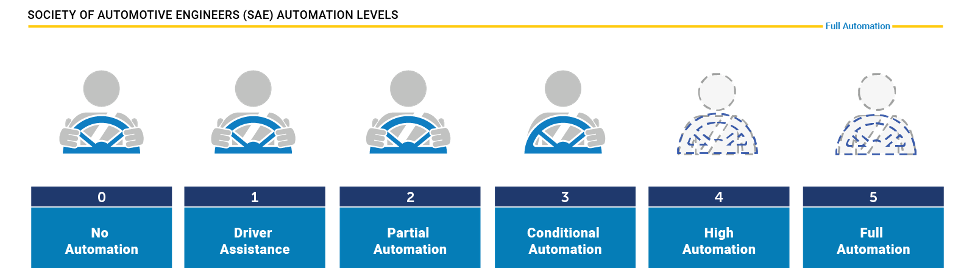
Level 0: These vehicles have no automation. The driver does all the driving.
Level 1: There are some ADAS features in these vehicles. ADAS may assist the driver with driving tasks, but the driver must still operate the vehicle. In addition, the driver must monitor the system.
Level 2: There are some ADAS features in these vehicles. ADAS can perform more driving tasks, but the driver must monitor the system at all times.
Level 3: The ADAS can fully operate the vehicle, but only under certain conditions. The driver must be ready to take over whenever the ADAS prompts it.
Level 4: These vehicles are fully automated, but they can only work under certain ideal conditions. When they are working, the driver does not need to monitor the system.
Level 5: These vehicles are fully automated. The vehicles can drive under any condition and there is no need for the driver to monitor the system.
Where does Adaptive Cruise Control (ACC) fit in?
Adaptive Cruise Control (ACC) is a level 1 automated system. Remember that this means that you and your vehicle equipped with ACC may share driving tasks. This is a significant change from level 0 automation, where you, the driver, have full responsibility for operating your vehicle in any environment.
The ACC system can provide brake/acceleration support to you by maintaining a set speed or detecting slower-moving vehicles in front of your vehicle and maintaining a certain set distance behind. Level 1 automation, and ACC in specific, cannot detect everything on the road or in the driving environment. In order to use the system properly and reap its benefits, you must understand how your role changes from driving with no automation to driving with a Level 1 automated vehicle.
Roles and Responsibilities
With increasing driver assistance system technology, the expectations of what you are responsible for while operating your vehicle must also change. While your physical driving tasks may decrease with advanced technology, you must learn to alter where you allocate your attention. In addition to operating some driving tasks that you are used to with manual driving, you must also take on a new role as a supervisor of the ACC system.
As a supervisor, you must now make sure that the system is working within its limits. To do so, you should have an understanding of how the system works. Then, you can scan the environment and know when the system may need your input or for you to take over.
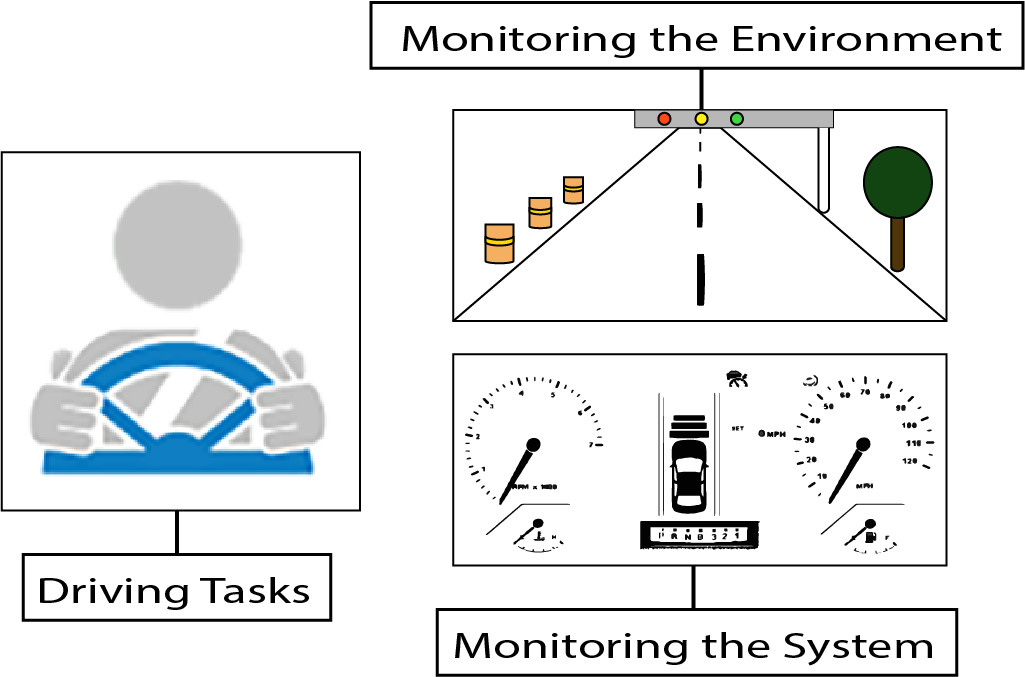
Driving Tasks: You must operate driving tasks. ACC can provide brake/acceleration support to you by maintaining a set speed or detecting slower-moving vehicles in front of your vehicle and maintaining a certain set distance behind them. However, even when ACC is operating properly, it cannot steer your vehicle, keep you between the lanes, or change lanes for you.
Monitoring the Environment: You must supervise the driving environment. There are limits on what ACC can detect. ACC is meant to detect slower-moving vehicles in front of your vehicle in order to maintain a certain set speed or distance behind that vehicle. It is not meant to detect road signs and may not operate in certain weather conditions such as in heavy rain or fog which could obscure other vehicles from being detected.
Monitoring the System: You must understand how to tell when the system is on and how it is functioning. The dashboard display allows your vehicle to communicate this to you. Understand what functions are operating while you are using ACC.